


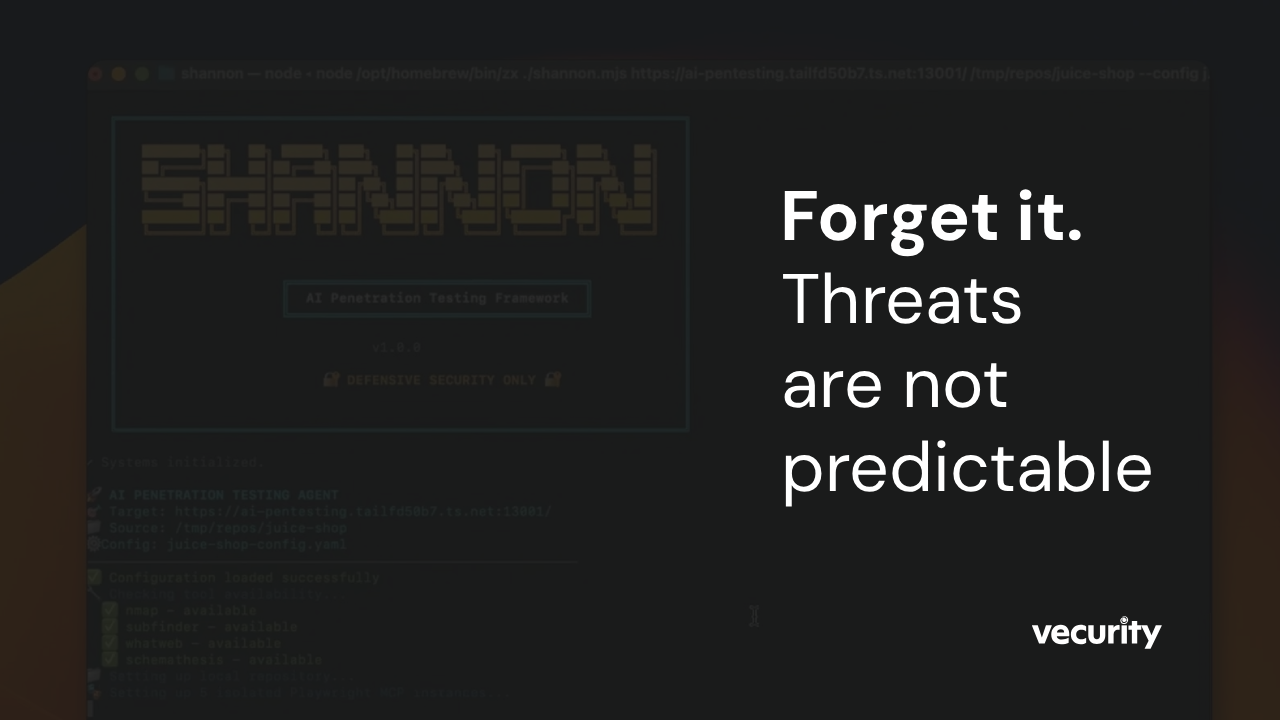
Automated scanners and AI pentest tools promised insight and control.
In reality, they are obsolete the moment they touch your system.
The future of security is not about discovery — it’s about proactive containment and damage minimization.
1. The Problem With Predictable Tools
Modern threats are not predictable.
They don’t wait for testing windows, blend into legitimate activity, and adapt faster than any report can be generated.
Relying on automated scanners gives a false sense of security.
- Scanners assume vulnerabilities can be discovered before exploitation — they can’t.
- Reports are static; threats evolve in real-time.
- Observation does nothing to stop damage.
2. Security Must Act Before Damage Happens
The next era of security isn’t reactive.
It’s proactive, dynamic, and intelligent:
- Pause risky modules and features before attacks escalate
- Throttle suspicious behavior in real time
- Isolate components to prevent lateral spread
- Reduce blast radius when anomalies occur
This is not about reports or dashboards.
This is about making vulnerabilities irrelevant before they matter.
3. Why Old Tools Fail
Automated scanners are still marketed as a solution, but they:
- Rely on predictable attack simulations
- Cannot handle continuous, adaptive threats
- Encourage false confidence in exposed systems
Security that relies on scanning is security that reacts too late.
4. The Vecurity Approach
We built the security of the future.
A system designed for unpredictable, dynamic threats:
- Edge-first detection and mitigation
- Module- and feature-level containment
- AI-assisted risk scoring to decide what to pause, throttle, or isolate
- Real-time resilience, not static reports
We don’t wait for attacks to happen.
We stop them in their tracks, wherever they appear.
Conclusion
Forget automated scanners.
Forget static playbooks.
Modern threats are unpredictable, fast, and adaptive.
The only way to stay ahead is to build systems that contain damage before it spreads.
That’s the future of security.
That’s Vecurity.